/01
The terms and conditions for playing
1.0 The playing area
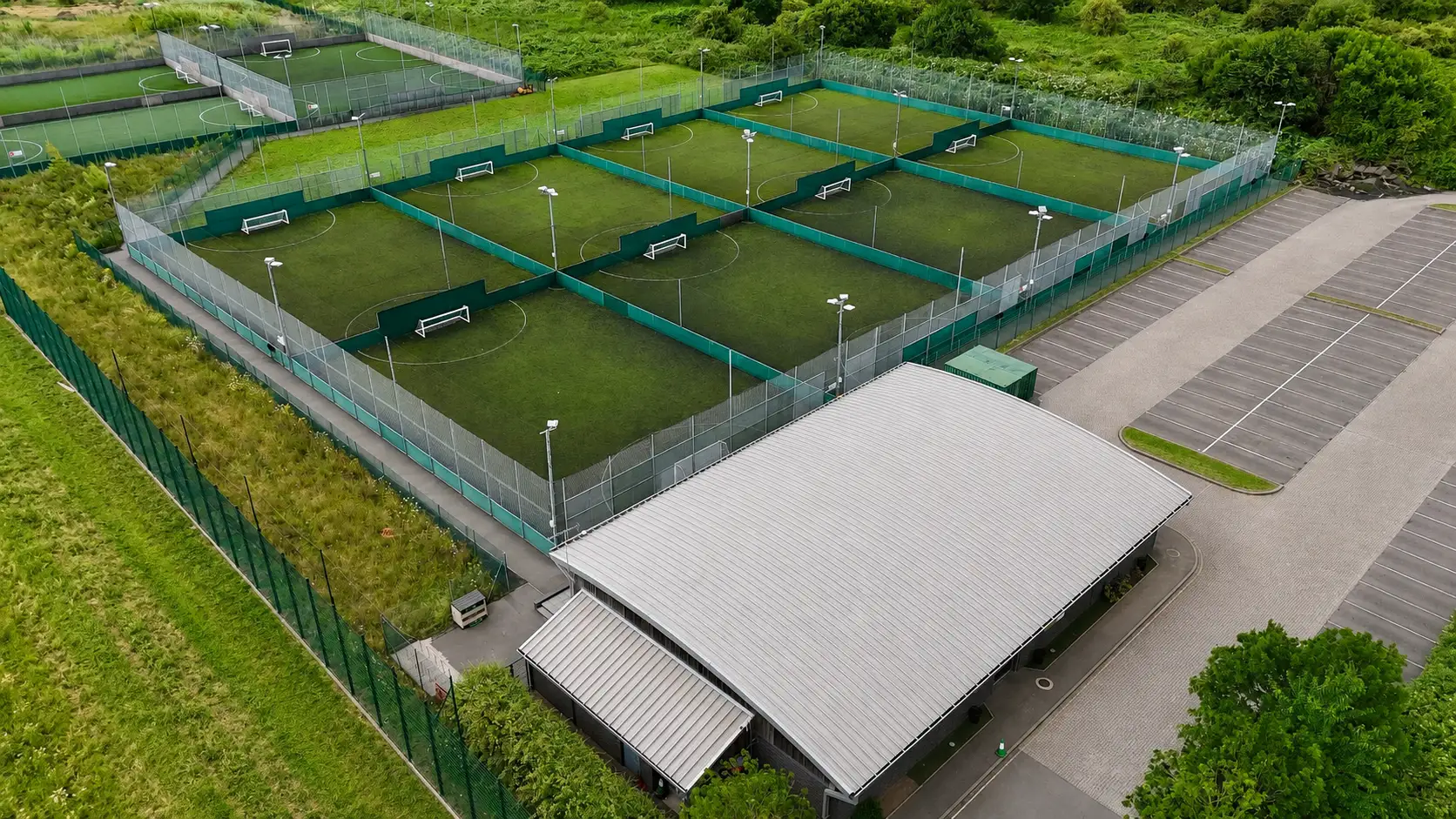
The pitch must be rectangular, with the length of the touchline greater than the goal line. Length must be between 25m and 50m; width must be between 16.5m and 35m.
The centre mark is indicated at the midpoint of the pitch and the pitch is surrounded by barriers which mark the boundaries.
Goals must be placed in the centre of the two smaller boundaries. Goals may be portable but must be securely anchored.
The distance between posts must be between 3m and 5m, and the crossbar height must be between 1.2m and 2m. Goalposts and crossbars have a width and depth of 8cm.
The playing surface must be flat and even and may be artificial.
The ball must be spherical, made from leather or another suitable material, and of a suitable size for the age group playing. If the ball bursts or becomes defective, play stops, the ball is replaced and play restarts with a drop ball from where it became defective.
2.0 A Gôl Centres Limited league
Each 5 or 7-a-side division will consist of a minimum of four and a maximum of twelve teams.
A league season will normally involve each team playing every other team twice. Smaller divisions may use a different procedure so all divisions can finish at the same time.
Three points are awarded for a win, one for a draw and no points for a loss.
League position is decided by total points, results between teams, goal difference, then goals scored.
Gôl policy is that two teams are promoted and two teams are relegated from each division at the end of the season. If teams do not re-register, withdraw or are withdrawn, Gôl Centres Limited may promote, relegate or alter fixtures within reason at any time.
3.0 Team entry
Teams may be entered by the organiser completing the online league application, player registration and paying the Good Faith Bond in full.
New teams may be placed on a standby list and may need to play grading games while waiting for a suitable league place.
Gôl Centres Limited may enter new teams into vacated league spaces at any stage during the season.
Teams owing money may not be allowed to enter a new season. Teams with outstanding balances risk losing their place to teams on the standby list.
Team organisers must sign the league agreement form, noting the liability disclaimers. Failure to sign may result in withdrawal from the league.
4.0 Player registration and availability
All adult league players must be at least 16 years old. The team organiser must be at least 18 years old.
Players may be registered by a team up to 48 hours after a match by a team member or Gôl Centres staff member.
Teams may register between 5 and 15 players per season for 5-a-side, or up to 20 players for 7-a-side. All players must be registered on the online portal.
Eight players may be selected for a 5-a-side match: 5 players and 3 substitutes. Ten players may be selected for 7-a-side: 7 players and 3 substitutes.
Players registered to one team may not transfer to another team in the same division during the same season, unless agreed by both teams and Gôl Centres with a designated cooling-off period.
Any team fielding a suspended player will have the match awarded to the opposition as a 10-0 win, receive no match fee reimbursement and have one point deducted. Additional deductions or expulsion may apply for deliberate or persistent breaches.
Teams deliberately falsifying team sheets will have the match awarded to the opposition as a 10-0 win and one point deducted.
Guest players may be used only when a team has already registered the maximum number of players and still cannot raise a side. Guest players may not be permanently registered to another team in the same division.
A stand-in player in the same division may only make the team up to the fourth player, must leave if registered players arrive after kick-off, must not be suspended and must have permission from Gôl Centres Limited management before kick-off.
Team organisers must keep guest appearance records. Persistent guesting may result in removal from the league if a replacement side is available.
Individual players are responsible for ensuring they are registered. Unregistered players may be suspended from all leagues for a period determined by Gôl Centres management, with repeat offences leading to increased suspensions.
5.0 Prior to a league fixture
The team organiser must pay the match fee online and nominate the maximum 8 players for 5-a-side, or 10 players for 7-a-side.
The referee will not start the game until they have received the team's match token.
A team arriving late begins 1-0 down. One further goal is awarded for every additional 4-minute period after scheduled kick-off. After 12 minutes the offending team concedes the game and the game length is reduced accordingly.
6.0 Cancellations, postponements and rearrangements
All games must be played as per the original fixture list unless adverse weather makes pitches unplayable, or a public holiday closure applies. Any weather cancellation decision can only be made by Gôl Centres Limited management.
If the centre is closed for a public holiday, fixtures will be rearranged by Gôl Centres Limited staff. Once agreed with the team organiser, the rearrangement is final.
A team may usually request only one rearranged game per season. At the Centre Manager's discretion, a second request may be allowed in exceptional circumstances such as bank holidays.
Requests must be made in writing, dated and witnessed by a member of staff, ideally by email to the centre's main address.
| Notice period | Opportunity to rearrange |
|---|
| More than 14 days | The League Co-ordinator will rearrange the match for a date before the end of the current season that both sides can agree. If it is not played by season end, the result is awarded against the team that requested the move. |
| Less than 14 days but more than 48 hours | The match can be rearranged, but must be played before its original scheduled date. If both sides cannot agree, it must be played as originally listed. If not played, a walkover is awarded against the requesting side and both teams' match fees are due. |
| Less than 48 hours | Gôl cannot rearrange with less than 48 hours notice, but will help find players where possible. If the game is not played, a walkover is awarded against the side and both teams' match fees are due. |
7.0 League replacements and withdrawals
If a team pulls out or is removed during a season, Gôl Centres Limited will try to replace them from the standby list.
If a replacement cannot be found immediately, scheduled fixtures are awarded to the opposition as 10-0 wins with 3 points. Results already played against the exiting team will stand.
A withdrawing team will be billed the full match fee for unfulfilled league games until their place has been filled or the season ends.
8.0 Payment
Teams must fulfil all fixtures and are liable for the fee whether the game is played or not.
If a team fails to attend a scheduled game or rearrangement, the opposition receives a 10-0 forfeit win and 3 points, provided they are available to play a friendly match. The offending team is docked 1 point.
The cancelling or absent team will be billed for both teams' match fees. Match fees or Good Faith Bonds must be repaid within 5 days.
Failure to pay may result in removal from the league. Debts may be subject to debt collection in the name of the team organiser.
Junior leagues may use local rules at the Duty Manager's discretion. Repayment schemes can be arranged for organisers to pay outstanding bills over three weeks.
If a game is abandoned with neither team at fault, the remainder will be played at a convenient time. Original fees are retained and the replay is arranged free of charge.
9.0 Behaviour
Any player consuming alcohol before a league game, or thought to be under the influence of drugs, prescription or otherwise, will not be permitted to play and risks the game being abandoned.
Gôl Centres Limited may prevent anyone entering the premises if their behaviour or appearance is unsuitable.
Rude or abusive language, threats or violence towards guests or staff will not be tolerated.
Racial, homophobic or misogynistic abuse, and any acts of discrimination, will result in a life ban from all Gôl Centres Limited establishments.
Players must obey notices and signs. Children and junior members under supervision must keep to displayed rules, and players are responsible for their children while on the premises.
Unless attending an organised Gôl activity, children under 16 must be supervised by a parent or guardian at all times.
Teams are responsible for their supporters. Persistent nuisance by supporters may result in league exclusion. Referees may remove unruly supporters from pitch side or abandon the game.
If a supporter verbally abuses the referee or opposition, the game will stop until the individual is in the building. Continued abuse will result in the game being awarded to the opposition as a 10-0 win.
Threatening or harming any referee or Gôl Centres Limited staff member will result in a life ban, referral to relevant national associations and police involvement.
10.0 Health and safety
Shin pads must be worn at all times during the game, including by goalkeepers.
Jewellery must be removed or taped up during matches, including by goalkeepers.
In the event of fire, players and guests should calmly use the nearest clearly marked exit.
Crockery and glass must not be taken into changing areas or onto pitches.
Smoking is not permitted on the premises.
Pets are not allowed on the premises or grounds, except guide dogs.
11.0 - 15.0 Premises, property and monitoring
Pitch fees do not cover lockers. Lockers can be hired daily, and lost keys are charged to the hirer. Property stored in lockers is entirely at the hirer's risk.
Gôl Centres Limited is not responsible for items removed from unpaid lockers or items left behind.
Lost property should be handed to reception and is retained for a maximum of 2 weeks before it may be given to charity.
Players and guests must park only in designated spaces. Motorbikes and scooters must not be parked beside pitches.
Gôl Centres Limited may clamp or remove vehicles parked outside designated areas or improperly parked in disabled spaces, and accepts no responsibility for loss or damage to vehicles.
Phone calls between players, guests and staff may be recorded.
Gôl Centres Limited premises are covered by CCTV and activity is recorded 24 hours a day.
16.0 Liability
Gôl Centres Limited liability for damage or loss to user property is limited to damage or loss caused by Gôl Centres Limited negligence.
With that exception, Gôl Centres Limited does not accept liability for user property brought onto the premises, stored in lockers, or kept in vehicles parked on Gôl Centres Limited property.
Staff are forbidden to hold valuables, including locker keys, on behalf of players.
Gôl Centres Limited cannot accept liability for accidents or injuries on the premises or grounds except where liability arises from Gôl Centres Limited negligence. Accidents and injuries must be reported immediately to the Duty Manager.
17.0 Physical activity
Five-a-side is vigorous. Players and guests should only participate at a level that reflects their fitness and are responsible for monitoring their own condition during play.
If any player or guest suffers an unusual reaction or feels unwell, they must stop the activity immediately and report it to the Duty Manager.
/02
The laws of the game
Law 1. The number of players
A match is played between two teams, with a maximum of 5 players, or 7 in 7-a-side, one of whom is the goalkeeper.
The minimum number permitted is 4 players, or 5 in 7-a-side, one of whom must be the goalkeeper.
Up to 8 players may be named for 5-a-side, or 10 players for 7-a-side.
If a team is permanently reduced to 3 players, or 4 in 7-a-side, due to misconduct, the game is awarded to the opposition as a 10-0 win. This also applies if 3 players are in the sin bin at the same time.
Substitution procedure
A maximum of three substitutes are permitted. Substitutions are unlimited and replaced players may return.
Substitutions may only take place during a break in play when the referee deems the ball dead.
The entering player must wait until the substituted player has left the pitch and becomes active immediately on entering.
If a substitute enters and play resumes before the departing player leaves, play is stopped and restarted with an indirect free kick to the opposition from where the ball was when play stopped. If the ball was in the penalty area, the free kick is taken on the penalty line nearest the ball.
Changing goalkeeper
Any outfield player or substitute may change places with the goalkeeper.
The referee must be informed before the change, the change must happen during a stoppage, and the referee must be satisfied there is no deliberate time wasting.
The replacement goalkeeper must wear a jersey that distinguishes them from all other players.
Law 2. Players' equipment
A player must not use equipment or wear anything dangerous to themselves or another player.
Jewellery must be removed or taped, including rings worn by goalkeepers.
Compulsory equipment includes a jersey or shirt, shorts or tracksuit bottoms, socks, shin guards and suitable footwear.
Outfield players should wear a recognisable strip of the same colour and goalkeepers must be distinguishable.
Footwear must be astro-boots, soft rubber moulded boots or trainers. Screw-in studs and blades are not permitted.
The referee will not allow a game to take place if players are not properly attired. If equipment cannot be corrected, the game is awarded to the opposition as a 10-0 win and the infringing team forfeits its match fee.
Law 3. The referee
Each match is controlled by a referee with full authority to enforce the laws from the moment they enter the locality of the pitch until they leave.
The referee enforces the laws, applies advantage, keeps a match record, acts as timekeeper, stops or terminates matches where required and takes disciplinary action.
The referee may act against team officials or supporters who fail to behave responsibly and may expel them from the playing area or abandon the game.
The referee ensures no unauthorised people enter the pitch, stops play for serious injuries, ensures bleeding players leave the playing area and checks the ball conforms to requirements.
The referee may use timed suspensions to temporarily exclude players and makes excluded players aware when their suspension ends.
For matters relating to a specific game, the refereeing of the game and application of the rules, the referee's decision is final.
Law 4. Start of play
The choice of ends is decided by a coin toss. The team winning the toss chooses ends and the other team kicks off.
Kick-off starts or restarts play at the start of the match, after a goal, at the start of the second half and at the start of extra time where applicable.
A goal may be scored direct from kick-off, but the initial kicker may not touch the ball a second time before another player touches it.
Players must be in their own half, opponents must be at least 2m from the ball, or 5m in 7-a-side, the ball must be stationary on the centre mark and play begins when the ball is kicked.
A dropped ball restarts play after a temporary stoppage. If the ball was in the goalkeeper's possession, the goalkeeper returns it underarm from the penalty area at the referee's signal.
Law 5. The ball in and out of play
The ball is out of play when it wholly crosses the goal line, becomes caught in the catch netting, leaves the confines of the pitch, or play has been stopped by the referee.
After a goal, the opposing team restarts with kick-off. If the ball catches in the netting or leaves the pitch, it is returned to play by the nearest goalkeeper.
The ball is in play at all other times, including when it rebounds from a goalpost, crossbar, kickboards or the referee.
In 5-a-side, the ball must not travel above board height, defined by the height of the current pitch kickboards. The referee's decision on height is final.
If the ball rebounds from a crossbar, goalpost, kickboard, referee or goalkeeper and travels above board height, play continues.
Heading is not permitted in 5-a-side. In 7-a-side there is no height restriction and players can head the ball.
If the ball travels above board height, play restarts with an indirect free kick to the opposition from where the ball began to rise.
Law 6. The method of scoring
A goal is scored when the whole ball passes over the goal line, between the posts and under the crossbar, unless carried, thrown or intentionally propelled by the attacking side's hand or arm.
A goal may be scored from any point outside the goal area and within the field of play. Goalkeepers may not score in the opponents' goal.
The team scoring more goals wins, unless disciplinary matters preclude them. If scores are equal or no goals are scored, the match is drawn.
Competition rules may use extra time or penalty kicks to decide individual matches that end level.
Law 7. Offside
There is no offside.
Law 8. Fouls and misconduct
Direct free kick offences
A direct free kick is awarded for careless, reckless or excessive-force offences including kicking, tripping, jumping at, charging, striking, pushing an opponent or forcing a player into the boards.
A direct free kick is also awarded for holding, spitting, making a sliding tackle, deliberate handball except by the goalkeeper, or failing to allow a cornered ball player to return the ball to play within 5 seconds.
A direct free kick is taken from where the infringement occurred. Defenders must be at least 2m away, or 5m in 7-a-side. Free kicks must be taken 2m from kickboards or goal areas.
Penalty kicks
A penalty is awarded if a player deliberately enters their own goalkeeper's area to play the ball or gain an advantage.
A penalty is awarded if a goalkeeper deliberately leaves the penalty area to play the ball. Momentum carrying them out after playing the ball inside the area is not an infringement.
Only outfield players may take penalty kicks during the game, except in competitions where local rules apply. Penalties must be taken using the one-step rule.
Indirect free kicks
An indirect free kick is awarded if a goalkeeper returns the ball with anything other than an underarm bowling action, deliberately passes or kicks it, holds it for more than 6 seconds, or receives it directly back from the same player before another player touches it.
Indirect free kicks are also awarded for dangerous play, impeding, an attacking player entering the opposing goalkeeper's area, the ball travelling above board height, playing the ball while on the ground, heading the ball, or any other offence requiring play to stop for a caution or dismissal.
If the infringement is by the goalkeeper, the indirect free kick is taken 2m from the goal area at the nearest point to the infringement.
/03
Discipline procedures
Discipline process
Gôl Centres Limited administers a discipline process that takes into account the FA's Laws of Small Sided Football.
Team lists are verified by organisers before league and cup matches. Disciplinary action will be taken against teams submitting false information or playing suspended players.
Suspended players are not permitted to play at Gôl Centres Limited for any affiliated team while serving a suspension.
Referees must submit reports detailing red card incidents.
Disciplinary sanctions
Gôl Centres Limited operates its own disciplinary code for blue and red card offences, in excess of the minimum guidelines approved by the Football Association Council for small-sided football.
Temporary suspensions, red-card exclusions, fines, point deductions and temporary or permanent exclusion of players or teams may be applied at the Centre Manager's discretion.
Yellow cards are no longer used in small-sided football and are replaced by blue cards.
A player may be shown a blue card and temporarily suspended for 4 minutes, issued a second blue card and permanently excluded, or issued a red card and permanently excluded.
1. Temporary timed suspensions - sin bin
A player shown a blue card must leave the pitch and remain in the designated sin-bin area for 4 minutes.
The referee informs the player when the suspension period is over.
Blue-card offences include unsporting behaviour including slide tackles, dissent, persistent infringement, delaying restart, failing to respect restart distance, entering or re-entering without permission, substitution infringements and deliberately leaving without permission.
For these offences, an indirect free kick is awarded to the opposing team from where the infringement occurred.
The offending team must play with 4 players, including the goalkeeper, for the full 4-minute suspension.
2. Sending-off offences and red cards
A player is sent off for serious foul play, violent conduct, spitting, denying a goal or obvious scoring opportunity by deliberate handball or foul, offensive or insulting language, racial or homophobic abuse or discrimination, a dangerous foul causing an opponent to hit the boards, or receiving a second blue card.
If play stops because of abusive language or a second blue card without another infringement, play restarts with an indirect free kick to the opposition where the infringement occurred.
A sent-off player may take no further part and must leave the area for the pavilion or changing room. The referee may abandon the game if the player refuses.
3. Violent conduct and repeat offences
Two blue cards in a game means the player automatically misses the next two weeks' fixtures or is liable for a £5 fine.
A player sent off for violent conduct is immediately suspended for at least 10 weeks, and possibly indefinitely, from all Gôl Centres Limited league setups.
Attempts to harm or threaten a referee by a player or team result in a life ban, referral to national associations, police involvement and possible removal of the whole team from the league.
Violent conduct on or off the pitch results in immediate suspension for the duration of the game and further sanctions at centre management discretion.
A player returning from violent conduct suspension is placed on 26-week probation. Reoffending within that period leads to a further 6-month ban, followed by another 26-week probationary period. Further reoffending can lead to an indefinite ban.
All suspensions carry forward into subsequent seasons.
7. Match abandonments
If a team fails to appear after the allotted 12 minutes, the opposition receives 3 points and a 10-0 win. The offending team is docked 1 point and receives no match fee reimbursement.
If a match is abandoned by the referee, the offending team forfeits 10-0 unless the existing score is already greater in the opposition's favour.
If both teams are at fault, both receive 10-0 forfeits against them. There is no match fee reimbursement.
If neither team is at fault, a full-length replay from 0-0 decides the match. Original fees are retained and the replay is free of charge.
If a team voluntarily leaves the field without fulfilling the fixture, this may be treated as resignation from the league. The team may be removed immediately and charged for remaining fixtures.
8. Complaints
League teams may complain about league setup, opposing teams, referee decisions and management decisions by submitting an accurate written appeal.
Appeals must be made in writing to Gôl Centres Limited Management no later than 48 hours after the fixture.
Communication about complaints or grievances will be exclusively between the team organiser and Gôl Centres Limited. Third-party reports are held in strict confidence.
Management may overturn any rule where a team is deliberately using an interpretation to gain an unfair advantage.
Gôl Centres Limited cannot overrule bans or fines issued by the relevant FA association; those appeals must go directly to the FA.
Gôl Centres Limited may alter these rules without prior consultation and management will decide matters of discipline not covered above.
Gôl Centres Limited reserves the right to ban any individual or team from future participation. Management decisions on league management are final.